
FDA Compliant Cosmetic Jar Supplier: 7 Documents to Check
“FDA compliant” is a sales phrase. It is not a certificate.
The US has no approved jar. There is no FDA approval for a cosmetic jar, and no FDA certificate to hang on a wall.
What you can collect is seven documents. This is how to read them.
1. What “FDA compliant” actually means for a jar
Start with what FDA does not do.
FDA does not approve cosmetics before they reach the market. Color additives are the one exception. Everything else goes on sale without pre-market sign-off.
So there is no “FDA approved jar.” A vendor selling you one is selling a phrase.
Responsibility sits with the brand. Under US law the brand owns the finished product. The jar plant sits upstream of that.
A real FDA compliant cosmetic jar supplier can prove three things, and only three. Where the material came from. What has been tested on it. What will change without telling you.
That is the claim. Anyone promising more is overselling.
2. MoCRA: who registers, and who does not
MoCRA is the 2022 US cosmetics law. It added facility registration and product listing. It did not add product approval.
Here is the detail that trips up buyers. A plant that fills product into a container counts as manufacturing. So a brand’s contract filler has to register.
An empty jar maker does not. No product goes in at that plant.
Ask a supplier for its FDA registration number and watch what happens. Some will send one. Then ask whose name is on it. Often it belongs to their customer, the filler.
Registration is not approval, either. A registered facility is not a compliant product.
There is a second line, unrelated to FDA. It is whether the plant runs as an ISO 9001 cosmetic packaging factory. That one speaks to consistency, which matters more week to week than a registration number.
3. The seven documents that carry the weight
This is the list. Ask for all seven in one go.
| # | Document | Who issues it | What to read | When it expires |
|---|---|---|---|---|
| 1 | Resin grade statement plus TDS | Jar plant and resin supplier | Grade name, melt index, virgin or regrind | On any material change |
| 2 | SDS | Jar plant | Composition, restricted substances | Within 3 years |
| 3 | Heavy metal and phthalate report | Third-party lab | Sample identity, method, date | 2 to 3 years |
| 4 | BPA and BPS free declaration | Jar plant | Which parts it covers | On any material change |
| 5 | Food contact or 21 CFR statement | Resin supplier | Whether it applies at all | Per project |
| 6 | Prop 65 statement | Jar plant | Listed substances, warning need | Per project |
| 7 | Batch traceability and change notice | Jar plant | Batch code, written notice | Ongoing |
Two rows need a word.
Row 5 is where buyers misread the law. The 21 CFR 174 to 178 framework covers food contact. A cosmetic jar is not food packaging. Some buyers still ask for it, mostly for lip or children’s products. Treat it as your own requirement, not a legal one.
Row 7 is the one nobody asks for and everybody needs. More on that in section six.
4. Reading a test report: four things that make it real
A report is either evidence or decoration. Four checks separate them.
The lab. Look for ISO 17025, CNAS or CMA. The letterhead should be a laboratory, not a trading company with a logo.
The sample. It has to describe your jar. Material, color, capacity, batch. A report reading “plastic jar, white” tested nothing you can use.
The method. Heavy metals are commonly run to EN 71-3. Phthalates are commonly run to CPSC-CH-C1001-09.4. A report with no method number cannot be cited to a retailer.
The date. Anything older than three years is a different material by now. Resin suppliers reformulate.
One more habit. When a BPA free cosmetic jar supplier makes that claim, ask which parts it covers. Many cover the body only. The gasket and the inner liner are plastic too.
5. Red flags in a compliance pack
Seven signs, in the order they usually appear.
- A certificate with FDA printed on it. FDA does not issue these.
- An FDA logo on the website. FDA does not license it that way.
- A report with no sample photo and no lab letterhead.
- The same report, different customer name on page one.
- A recent date over a method standard from twenty years ago.
- No SDS, plus the sentence “all our material is food grade,” with no grade name.
- A claim of being an SGS tested cosmetic jar supplier, with no report number to check.
Any two of these together is enough to walk and look for another FDA compliant cosmetic jar supplier.
6. Change control is where compliance breaks
Compliance is not an event. It is a consistency problem.
Four things break consistency. A colorant from a new source. A higher regrind ratio. A substitute resin grade. A mold re-cut in different steel.
Any one of them can void every document in section three. The jar still looks the same. The paperwork no longer describes it.
So write it into the agreement. Written notice before a change, and a retest after.
This is also where recycled content gets confusing. Ask a recyclable cosmetic packaging supplier two separate questions. Is the jar recyclable in the stream my customer uses. And what percentage is recycled content. The second answer needs a number and a fresh migration check.
7. Five questions to put in your RFQ
Copy these into the inquiry. Short questions get short answers, which is the point.
- Which resin grade do you use, and who supplies it?
- Can you send a heavy metal and phthalate report for this exact jar?
- Which lab ran it, and what is the report date?
- Do you provide BPA free and Prop 65 statements, and what do they cover?
- Will you notify us in writing before any material or colorant change?
A cosmetic grade plastic jar manufacturer that answers all five in one reply has done this before. One that answers with a brochure has not.
8. Send the list with your first inquiry
“Do you have FDA certification” gets a yes from everyone. It costs nothing to type yes.
Send the seven-document list instead. It asks for files, not opinions. Files are harder to fake.
The reply tells you more than the documents do. A supplier who sends five of seven and names the two missing is being straight with you. A supplier who sends one certificate and calls it compliance is not.
We work from the same list. Material grades, test reports and change notices go out with the sample, not after the order. Ask for the file pack with your first inquiry and it comes back with the quote.
Where this sits in the range
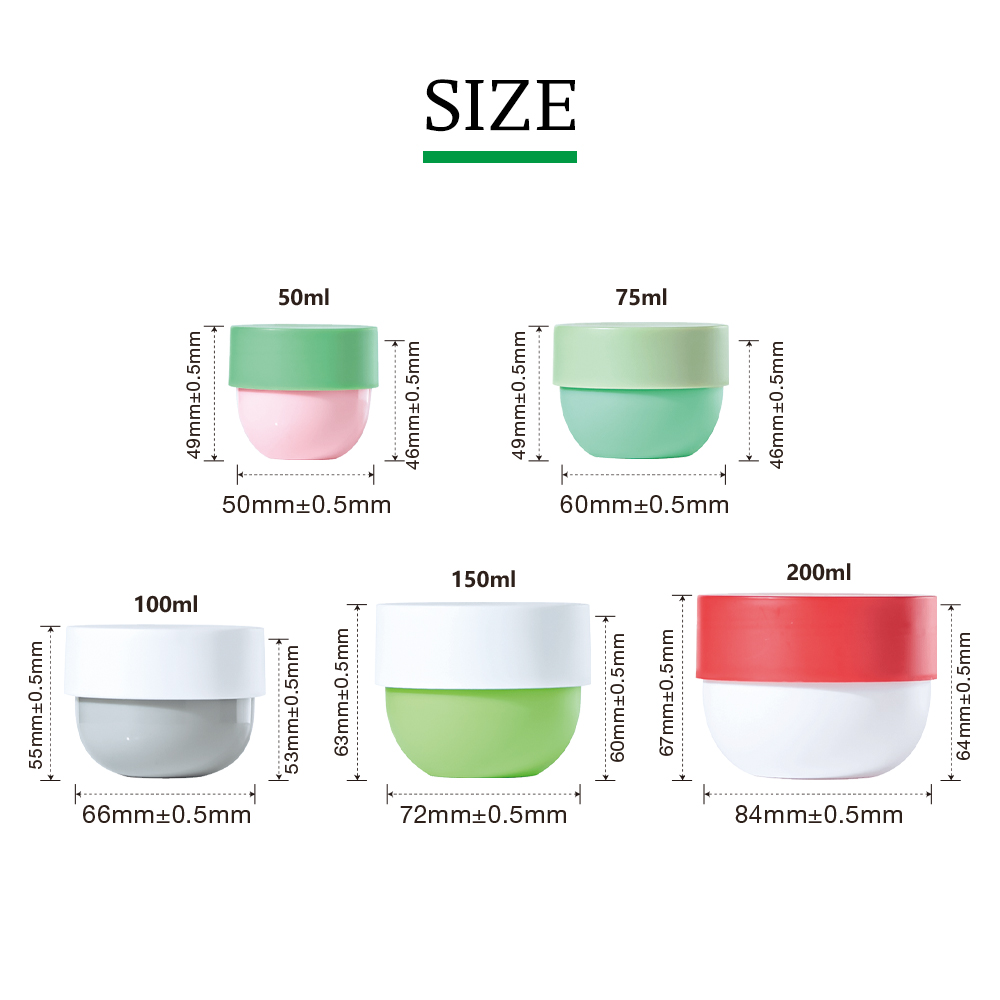
The documents above apply to every jar we mold, from 15g to 200g, across the cream jar range. Customization options and material choices are set out on the OEM page. If this is your first order from China, the sourcing side is covered under Beauty Packaging Buying Guide.
One closing note. A compliance pack is not a marketing asset. It is a stack of paper that has to survive a retailer’s question six months from now. Collect it before you pay, not after.